Teaching Music to Young Children: A Practical Guide
Young children learn music through play, movement and song. Practical strategies for teaching ages 3 to 7: short activities, singing, movement, simple instruments, managing attention and involving parents.
In this guide
Teaching music to young children is joyful, energetic and sometimes chaotic. Children aged three to seven learn very differently from older students: they learn through play, movement, imitation and repetition, and their attention spans are short. A lesson that would bore a ten-year-old can delight a four-year-old, and vice versa. This guide offers practical strategies for teachers working with young children, whether in private lessons, group classes or early years settings.
How young children learn music
Young children learn through their bodies and senses. They experience rhythm by moving, pitch by singing and musical ideas through stories and play. Many influential approaches to early childhood music, such as Kodály, Orff and Dalcroze, emphasise singing, movement, games and exploration before formal notation. Children learn best when activities are concrete, playful and repeated often.
Keep activities short
A useful rule of thumb is that young children can focus on one activity for only a few minutes. Plan lessons as a sequence of short activities, each lasting two to five minutes, with frequent changes between sitting, standing and moving. A 30-minute lesson might include six to eight different activities. Transitions should be quick and fun, often marked with a song.
Sing, sing, sing
Singing is the foundation of early music education. It develops pitch, listening, memory, language and expression. Use songs with simple melodies, small ranges (around middle C to the A or C above), repetition and actions. Echo songs, call-and-response songs and songs with movements are especially effective. Sing in a light, clear voice at a pitch suited to children, not too low. See singing lessons for kids.
Move to the music
Movement helps children feel beat, tempo, dynamics and phrasing. March to a steady beat, tiptoe to quiet music, stretch tall for high notes and crouch for low ones, freeze when the music stops. Use scarves, ribbons or beanbags to make movement more engaging. Movement activities also help energetic children release energy so they can focus during quieter tasks.
Rhythm and pitch games
| Game | Skill | How it works |
|---|---|---|
| Echo clapping | Rhythm, memory | Teacher claps, children copy |
| High and low | Pitch | Children reach up or down for high and low notes |
| Fast and slow | Tempo | Move quickly or slowly to the music |
| Loud and quiet | Dynamics | Big movements for loud, tiny for quiet |
| Musical statues | Listening | Freeze when the music stops |
See rhythm clapping games and music theory games for kids.
Simple instruments
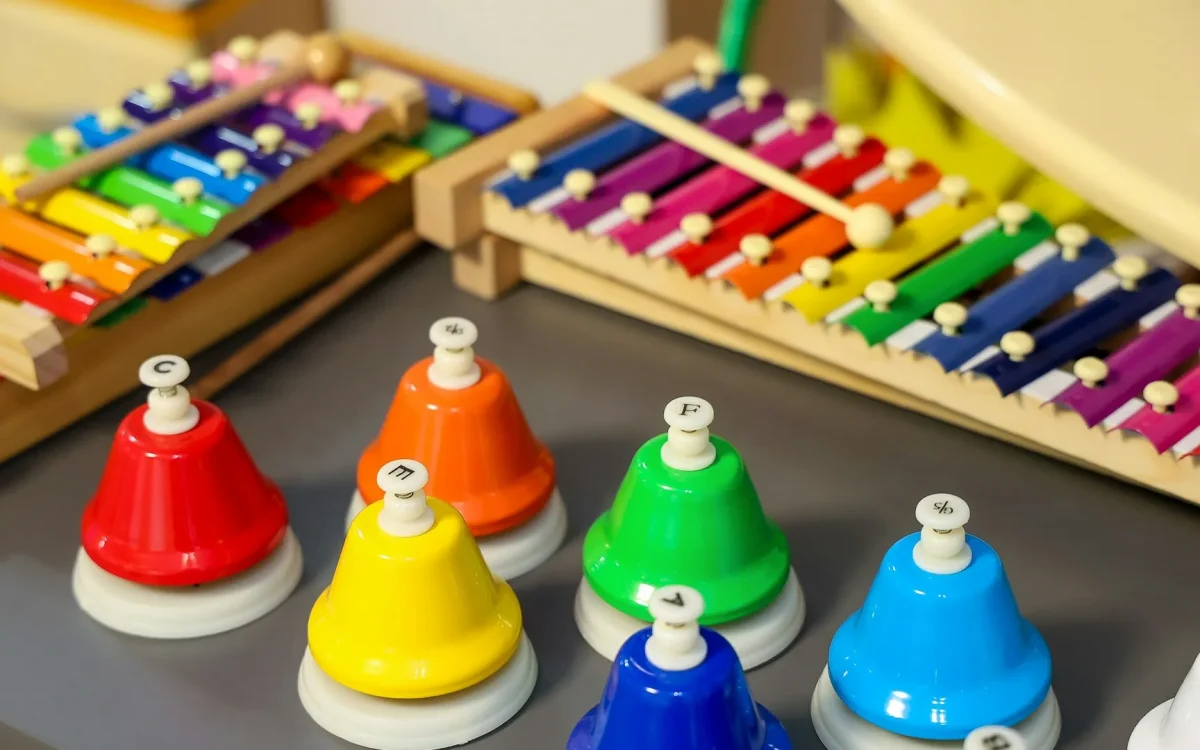
Percussion instruments such as shakers, drums, tambourines, rhythm sticks and xylophones let young children explore sound and play together. Introduce instruments with clear rules, such as “instruments rest on the floor until the signal”. Use them to keep a beat, play rhythms and add sound effects to stories. Tuned percussion, such as glockenspiels and xylophones, introduces pitch and simple melodies. See best xylophones and glockenspiels for kids.
Starting an instrument
Children from about five or six may begin a formal instrument, such as piano, violin or recorder, especially with an approach designed for young learners. Keep lessons short (20 to 30 minutes), use plenty of games and imitation, and introduce notation gradually. Parents’ involvement at home is especially important at this age. See what age to start music lessons.
Managing attention and behaviour
Young children behave best when lessons are well-paced, predictable and engaging. Use routines, such as a hello song and a goodbye song, so children know what to expect. Give clear, simple instructions, and demonstrate rather than explain. Praise specific good behaviour. When attention wanders, change the activity rather than pushing on. See lessons for kids who can’t sit still.
Involving parents
Parents are powerful partners in early music education. Share the songs and games from lessons so families can repeat them at home. In private lessons for young children, many teachers invite parents to sit in and help with practice. A short weekly note or message about what was covered helps parents support learning. See family music night.
A closer look: progress at this age
Progress with young children looks different from progress with older students. Rather than pieces learned or grades passed, look for steadier beat-keeping, more accurate singing, longer attention, growing confidence and joy in music. These foundations make later instrumental learning much easier. Celebrate small steps and keep the focus on enjoyment. Children who love music at five are far more likely to keep playing at fifteen.
Putting it into practice
Plan your next lesson for young children as a series of six to eight short activities, mixing singing, movement, games and instruments, with a hello and goodbye song. Share one song or game with parents each week. The Kids Music Activity Planner AI can generate age-appropriate activities, and the Lesson Plan Builder AI can structure complete lessons.
Frequently asked questions
How long should a music lesson for a 4-year-old be?
Around 20 to 30 minutes for a private lesson, or 30 to 45 minutes for a lively group class.
Should young children learn to read music?
Introduce simple symbols gradually through games, after plenty of singing and movement.
What if a child refuses to join in?
Let them watch. Many children join in once they feel comfortable.

Questions and notes