Learning Piano From Zero: A 12-Week Roadmap
A clear twelve-week plan for complete piano beginners of any age: what to learn each week, how long to practise, the skills that matter most and how to know you are on track.
In this guide
Starting piano can feel overwhelming. There are 88 keys, two hands, two lines of music and endless advice online. A clear plan makes it manageable. This twelve-week roadmap takes a complete beginner, child or adult, from never having touched a piano to playing simple pieces with both hands, reading basic notation and understanding a few chords. It works alongside lessons or as a guide if you are learning on your own.
Before you start
You need a piano or a keyboard with at least 61 full-size keys, ideally touch-sensitive or weighted. Set it at the right height with a stable bench or chair. Aim to practise fifteen to thirty minutes a day for adults, and ten to twenty for children. Short, daily practice beats long weekly sessions. See keyboard or piano for learning and how to sit at the piano.
Weeks 1–2: the keyboard and your hands
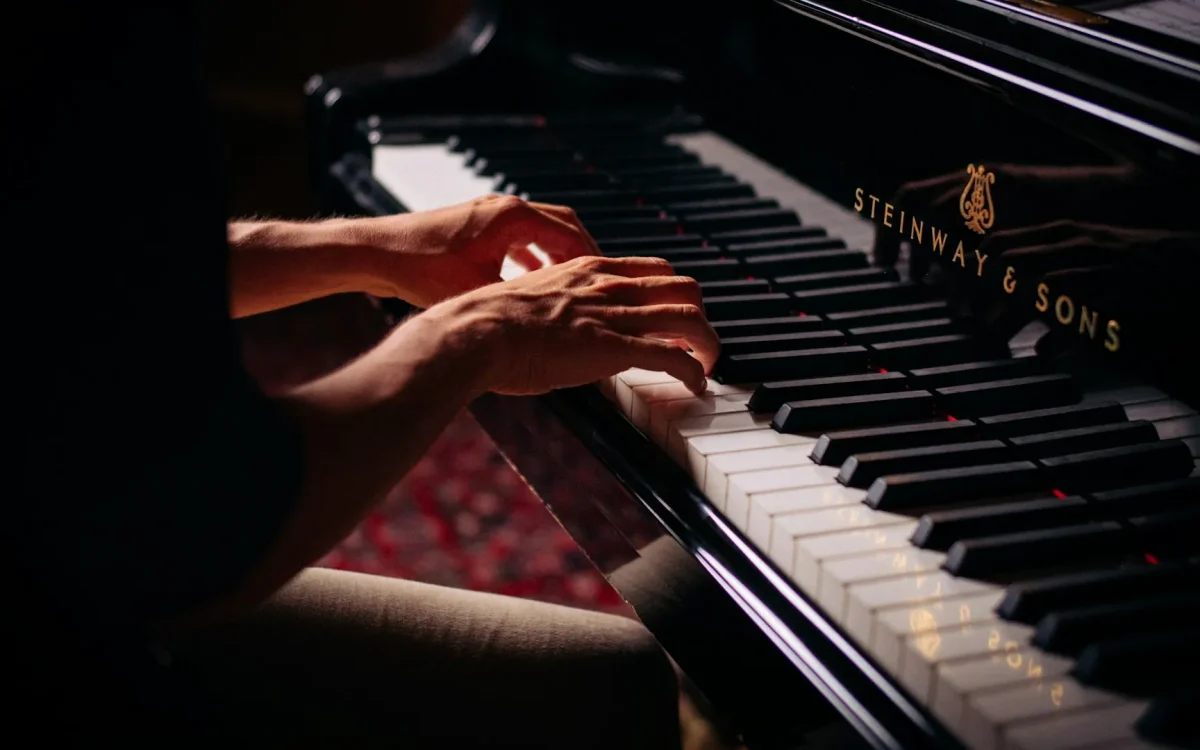
Begin by learning the geography of the keyboard. Find groups of two and three black keys and use them to locate every C, D and E, then all seven white-key notes. Learn finger numbers: thumbs are 1, little fingers are 5. Play simple five-finger patterns in each hand, slowly and evenly, with relaxed, curved fingers. By the end of week two, you should find any white key quickly and play C-D-E-F-G with each hand. Our first piano lesson covers this in detail.
Weeks 3–4: rhythm and first tunes
Add rhythm. Learn quarter notes, half notes and whole notes, and count aloud as you play. Play simple tunes within the five-finger position, first in the right hand and then in the left. Use a metronome at a slow tempo to keep the beat steady. Our free metronome is ideal. Milestone: play two short tunes in each hand while counting steadily.
Weeks 5–6: reading notes
Start reading treble clef notes around middle C, then bass clef notes. Use landmark notes and memory tricks, and practise a few minutes a day with flashcards or our note reading trainer. Play short pieces from a beginner method book, reading rather than memorising. See reading piano music on two staves.
Weeks 7–8: hands together
This is the big step. Begin with simple pieces where the left hand holds long notes while the right hand moves, then pieces where both hands move in simple patterns. Practise each hand separately first, then together very slowly. Count aloud. Expect this stage to feel awkward at first; it improves quickly with daily practice. Milestone: one short piece with both hands, slowly but steadily.
Weeks 9–10: chords and accompaniment
Learn the C, F and G major chords in the left hand, and play a melody in the right hand over them. Simple chord accompaniments unlock many songs. Learn A minor too. See piano chords for beginners.
Weeks 11–12: musicality and a performance
Add dynamics, playing loud and soft, and smooth legato phrases. Choose one piece to polish for a small performance for family or friends, or record yourself. Celebrate how far you have come. See making piano music expressive.
The roadmap at a glance
| Weeks | Focus | Milestone |
|---|---|---|
| 1–2 | Keyboard map, finger numbers, five-finger patterns | Find any white key; play C–G evenly in each hand |
| 3–4 | Rhythm, counting, first tunes | Two tunes per hand with steady counting |
| 5–6 | Reading treble and bass notes | Read and play simple pieces in each clef |
| 7–8 | Hands together | One piece with both hands |
| 9–10 | C, F, G and A minor chords | Melody with chord accompaniment |
| 11–12 | Dynamics, phrasing, performance | One polished piece performed or recorded |
How to practise each day
A good daily session includes a short warm-up of five-finger patterns, a few minutes of note reading, focused work on the current piece in small sections, and a final play-through of something you enjoy. Slow down whenever mistakes creep in. Our guide to how long to practise piano offers more detail, and the Piano Practice Buddy AI can build a personalised plan.
If you fall behind
Everyone learns at a different pace. If a stage takes longer, stay with it. Hands-together playing, in particular, takes some learners twice as long as others, and that is perfectly normal. The order of steps matters more than the speed.
Staying motivated through the twelve weeks
Most beginners feel a burst of excitement in the first two weeks, then a dip around weeks five to eight, when reading and hands-together playing feel slow. Expect this and plan for it. Keep one “fun” piece in your practice that you can already play well, record yourself every two weeks to hear your progress, and share small achievements with family or friends. Setting a date for a mini-performance at the end of week twelve gives the whole plan a goal to work towards.
Frequently asked questions
Can I follow this roadmap without a teacher?
Yes, many learners do. A few lessons, especially at the start, help with posture and hand shape. See learning without a teacher.
Is this roadmap suitable for children?
Yes, with shorter practice sessions and more games. Children may take longer on reading and hands together.
What comes after twelve weeks?
Continue with a method book, add scales in more keys, learn more chords and explore pieces in styles you love.


Questions and notes