Your First Three Guitar Chords: G, C and D
With G, C and D you can play hundreds of songs. Step-by-step finger positions, how to check each string rings clearly, common mistakes, practice exercises and easy songs to play.
In this guide
Three chords can take you a remarkably long way on the guitar. G major, C major and D major belong together in the key of G, and they form the backbone of countless folk, pop, country and campfire songs. Once you can play them cleanly and change between them in time, you can accompany yourself or others singing a huge range of music. This guide explains each chord step by step, shows you how to fix the most common problems and gives you songs to practise with.
Reading chord diagrams
Chord diagrams show the guitar’s neck as if it were standing upright in front of you. Vertical lines are the strings, with the low E on the left and the high E on the right. Horizontal lines are the frets. Dots show where to place your fingers, usually with a number for the finger: 1 is the index finger, 2 the middle, 3 the ring and 4 the little finger. An “O” above a string means play it open, and an “X” means do not play it. In this article, we describe each shape in words, so you can follow along with or without a diagram.
Warm-up: E minor
Before learning G, C and D, many teachers start with E minor because it uses only two fingers. Place your middle finger on the second fret of the A string and your ring finger on the second fret of the D string. Strum all six strings. E minor helps you get used to pressing strings with your fingertips, keeping your fingers curved and strumming across all strings. It also fits with G, C and D, so you can use it in songs later.
Chord 1: G major
Place your middle finger on the third fret of the low E string, your index finger on the second fret of the A string, and your ring finger on the third fret of the high E string. Strum all six strings. Some players use the ring finger on the low E and the little finger on the high E, which makes changing to C easier later; either fingering is correct. Check that the open D, G and B strings ring clearly and are not touched by the fingers on neighbouring strings.
Chord 2: C major
Place your ring finger on the third fret of the A string, your middle finger on the second fret of the D string, and your index finger on the first fret of the B string. Strum from the A string down, avoiding the low E. C major is often the hardest of the three for beginners, because the stretch is wider and the index finger can easily mute the open high E string. Keep your fingers arched so that only the tips touch the strings, and let your wrist drop slightly below the neck to give your fingers room.
Chord 3: D major
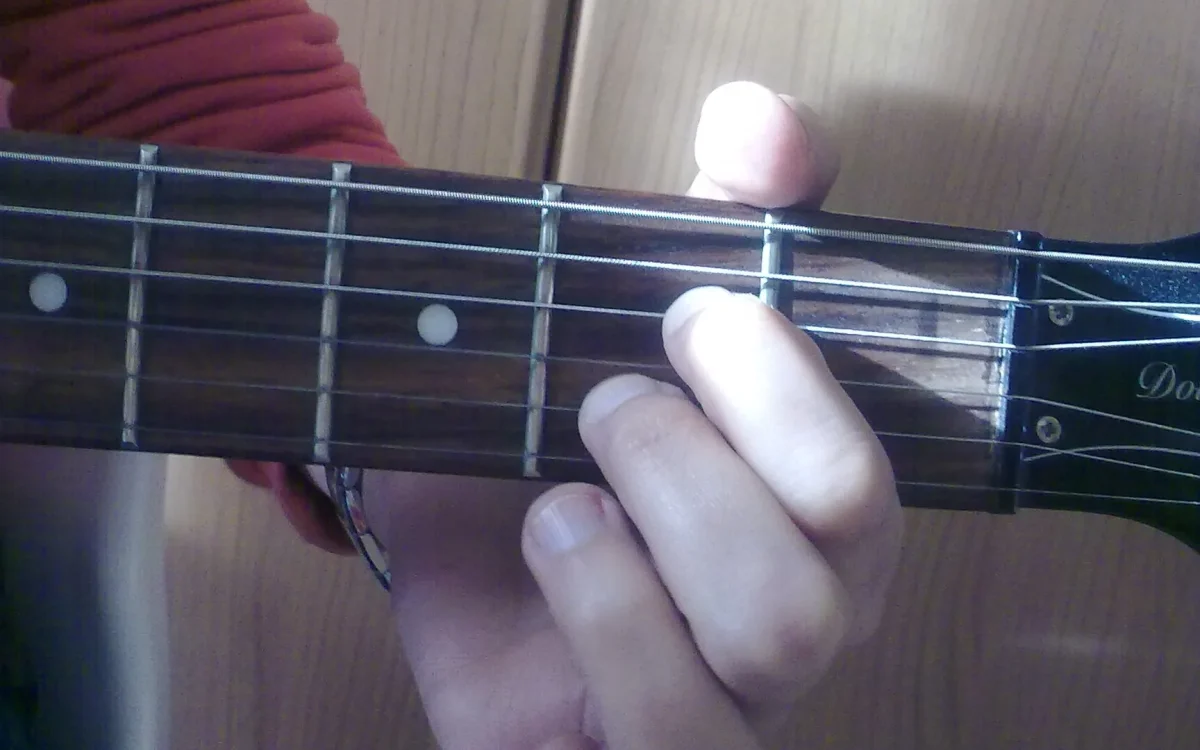
Place your index finger on the second fret of the G string, your ring finger on the third fret of the B string, and your middle finger on the second fret of the high E string. Strum only the top four strings, starting from the open D string. The fingers form a small triangle. Avoid strumming the low E and A strings, which make the chord sound muddy. Practise aiming your strum by starting from the D string slowly until it becomes automatic.
Checking every string
After placing each chord, play the strings one at a time from the lowest to the highest that belongs to the chord. Each note should ring clearly. If a string buzzes, press closer to the fret (just behind the metal fret wire, not on top of it or in the middle of the gap). If a string sounds dead or muted, a finger is probably leaning on it; arch that finger more steeply. This string-by-string check takes only a few seconds and quickly trains your fingers to find clean positions.
The three chords at a glance
| Chord | Fingers | Strings to strum | Common problem |
|---|---|---|---|
| G major | 2 on low E fret 3, 1 on A fret 2, 3 on high E fret 3 | All six | Muting the open B string |
| C major | 3 on A fret 3, 2 on D fret 2, 1 on B fret 1 | Five (from A) | Muting the high E string |
| D major | 1 on G fret 2, 3 on B fret 3, 2 on high E fret 2 | Four (from D) | Strumming the bass strings |
Changing between the chords
Practise changes in pairs: G to C, C to D and D to G. Switch back and forth without strumming at first, focusing on moving all fingers together as a unit rather than placing them one by one. Then strum once on each chord, counting four beats before you change. Use a metronome at a slow tempo, about 60 beats per minute, and increase it gradually. A useful exercise is the one-minute change: count how many clean changes you can make between two chords in one minute, and try to beat your score each day. See change chords smoothly.
Songs with G, C and D
Many traditional songs use only these three chords, which makes them ideal for practice. Try “Swing Low, Sweet Chariot”, “Oh! Susanna”, “When the Saints Go Marching In”, “Amazing Grace” and “Down in the Valley”. Search for chord sheets in the key of G, or ask your teacher. Start by strumming once per bar and singing or humming the melody, then add more strums as your changes improve. See graded practice songs for a progression of songs to learn.
A closer look: why these three chords work together
G, C and D are the first, fourth and fifth chords in the key of G major, often written as I, IV and V. In almost every key, these three chords sound like a family: the first feels like home, the fourth moves away gently, and the fifth creates tension that wants to return home. That is why so many songs use them. Once you understand this pattern, you will start to hear it everywhere, and learning new songs becomes easier because you can predict where the chords are likely to go. See what is a chord for a simple explanation.
Putting it into practice
Spend the first few days on each chord separately, checking every string. Then practise changes in pairs for five minutes a day, and finish each session by playing one simple song from beginning to end. Expect your fingertips to be sore at first; see sore fingertips and calluses. Within two or three weeks, most beginners can play a full song with these three chords. The Guitar Lesson Coach AI can suggest songs and exercises matched to your level.
Frequently asked questions
Which guitar chord should I learn first?
E minor is the easiest. G, C and D are the most useful first set for songs.
Why does my C chord buzz?
Usually a finger is not close enough to the fret or is touching a neighbouring string. Arch your fingers more.
How long does it take to learn G, C and D?
Most beginners can play them cleanly within one to three weeks of daily practice.



Questions and notes