What Can You Play After One Year of Guitar?
Realistic expectations for your first year of guitar: the chords, rhythms, songs and skills most learners reach with regular practice, how practice time affects progress and what comes next.

In this guide
When you start learning the guitar, it is natural to wonder where you will be in a year. Will you be playing full songs, joining friends, or still struggling with chords? The honest answer depends on how often and how well you practise, but there are clear milestones that most learners reach. Understanding what is realistic helps you set goals, stay motivated and notice your progress.
What affects your progress
The biggest factor is regular practice. A learner who practises twenty minutes a day will usually progress much faster than one who practises for two hours once a week. Lessons with a good teacher help you avoid bad habits and keep you on track. The type of music you want to play matters too: strumming folk and pop songs is reached sooner than classical pieces or fast lead guitar. Age plays a smaller role than many people think; adults often progress quickly because they practise deliberately.
Months 1–3: the foundations
In the first three months, most learners can hold the guitar comfortably, tune it, and play the main open chords: E minor, A minor, C, G, D, E and A. They can strum simple patterns and change between chords slowly but in time. By the end of this stage, many can play several simple songs from beginning to end. See the 12-week roadmap for a detailed plan of this stage.
Months 4–6: songs and rhythm
Between four and six months, chord changes become smoother and strumming patterns more varied. Most learners add more chords, such as D minor, E minor 7 and simplified versions of F. They learn to read tab and play simple melodies and riffs. Many start fingerpicking with a basic pattern. A typical learner at six months has a repertoire of ten or more songs and can play along with recordings of easier songs.
Months 7–9: the barre chord challenge
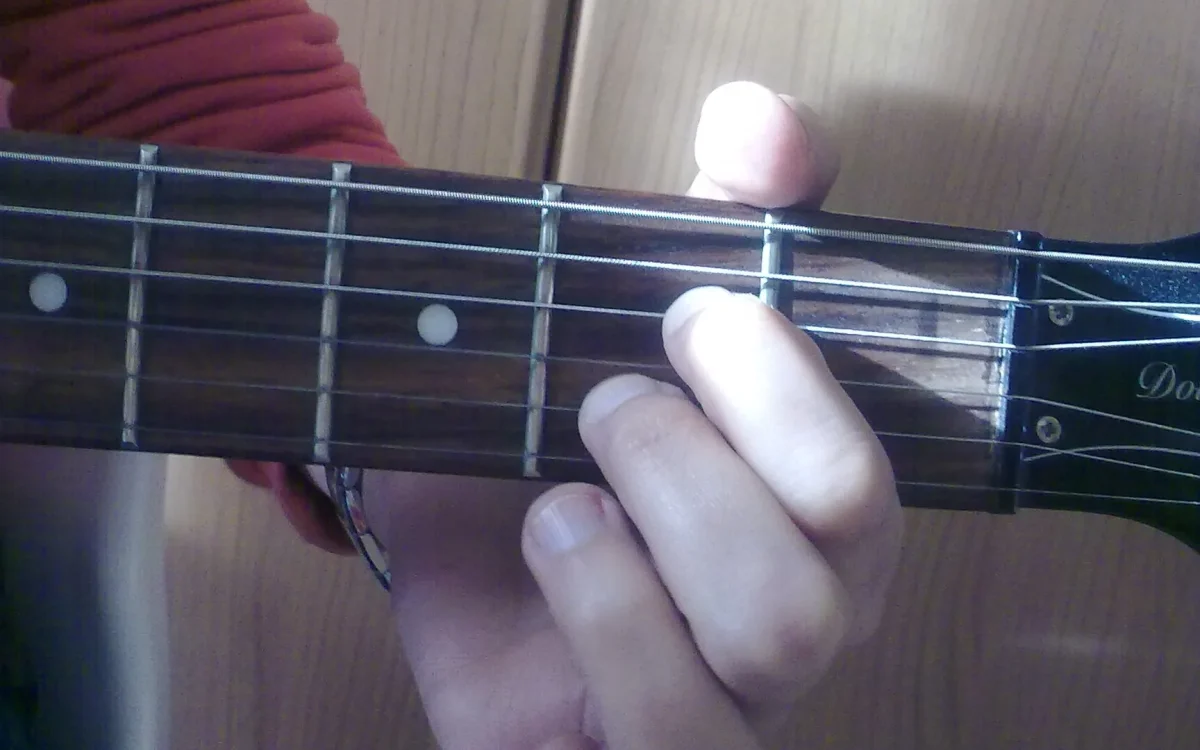
Barre chords, where one finger presses several strings at once, are a major milestone. F major is often the first, and it is notoriously difficult. Most learners need several weeks or months of practice before barre chords sound clean. Power chords are an easier alternative for rock music. This stage also often includes a first major or minor pentatonic scale, the basis for simple improvisation and lead playing.
Months 10–12: putting it together
By the end of the first year, a learner who has practised regularly can typically play a broad range of songs with open chords, use a few barre chords (even if not perfectly), fingerpick simple accompaniments, play melodies from tab and improvise a little with the pentatonic scale. Many can play with others, accompany singing, and perform a few songs confidently for family or friends.
First-year milestones at a glance
| Stage | Typical skills |
|---|---|
| Months 1–3 | Tuning, main open chords, simple strumming, first songs |
| Months 4–6 | Smoother changes, more patterns, tab, basic fingerpicking |
| Months 7–9 | First barre chords, power chords, pentatonic scale |
| Months 10–12 | Broad song repertoire, playing with others, simple improvisation |
How practice time changes the picture
A learner practising around ten minutes a day may reach the six-month milestones closer to the end of the first year. Someone practising thirty to forty-five minutes a day, with a teacher, may reach the one-year milestones in eight or nine months and go further. These are approximate; everyone learns at a different pace. What matters is consistent practice and steady improvement, not keeping up with someone else.
Classical guitar in the first year
Classical guitar students follow a slightly different path. In the first year, they typically learn to read standard notation on the guitar, play simple solo pieces and studies with fingerpicking, and develop correct right-hand technique. Many take a first graded exam within the first year or two. See graded music exams explained.
Signs of good progress
Progress is not only about songs. Signs that you are improving include tuning quickly without help, learning new songs faster than before, keeping a steady rhythm without thinking, hearing when something is out of tune or out of time, and recovering smoothly from mistakes. Recording yourself every few months is the best way to hear this progress, which is often hard to notice day to day. See track progress in music lessons.
A closer look: getting through the plateaus
Most learners hit at least two plateaus in their first year: one around chord changes in the second month and one around barre chords later. During a plateau, it feels as though nothing is improving, even with practice. This is normal. Keep practising slowly and correctly, vary your routine with new songs, and set small goals such as one clean barre chord change per minute. Plateaus usually end with a sudden improvement. Learners who quit during a plateau often do so just before a breakthrough.
Putting it into practice
Write down three goals for your first year, such as “play ten songs”, “play F major cleanly” and “perform two songs for family”. Review them every three months, and use the milestones above as a guide. Follow a daily routine such as our 15-minute practice plan. The Guitar Lesson Coach AI can build a plan around your goals and practice time.
Frequently asked questions
Is one year enough to get good at guitar?
One year of regular practice is enough to play many songs confidently, though mastery takes longer.
Why are barre chords so hard?
They need finger strength, precise positioning and the right pressure. Most learners need weeks of practice.
Can adults progress as fast as children?
Often yes. Adults usually practise more deliberately, which speeds up progress.

Questions and notes