Guitar for Kids: Sizes, Starting Age and First Steps
What age can a child start guitar, which size do they need, nylon or steel strings, and how parents can help. A practical guide to choosing the right guitar and making the first months fun.
In this guide
Many children dream of playing the guitar, and it is a wonderful instrument to grow up with: portable, sociable and suited to almost every style of music. But a full-size guitar is far too big for a young child, and starting at the wrong size or age can make the first months frustrating. This guide helps parents choose the right moment, the right guitar and the right approach.
What age can a child start guitar?
Most children are ready for guitar lessons from about six to eight years old. At this age, their hands are usually strong enough to press the strings, and they can concentrate for a short lesson. Younger children can enjoy strumming and singing on a small guitar or ukulele, but they may find chord shapes physically difficult. Readiness matters more than age: a child who is keen, can follow simple instructions and can practise for ten minutes is ready to begin.
Ukulele as a first step
For children under seven, a ukulele is often a better starting instrument. It has four nylon strings that are soft on small fingers, it is light and small, and simple chords need only one or two fingers. Skills learned on the ukulele, such as strumming, rhythm and chord changes, transfer directly to the guitar later. Many children start on ukulele at five or six and move to guitar at seven or eight. See best ukuleles for kids.
Guitar sizes explained
Guitars for children come in fractional sizes. The size is about the whole instrument, especially the scale length (the distance between the nut and the bridge), which affects how far the fingers must stretch. The table below gives typical guidance, but height and arm length matter more than age, so try a guitar in a shop if possible.
| Size | Typical age | Approximate child height |
|---|---|---|
| 1/4 size | 4–6 | Under 120 cm (about 3’11”) |
| 1/2 size | 6–8 | 120–135 cm (about 3’11″–4’5″) |
| 3/4 size | 8–11 | 135–150 cm (about 4’5″–4’11”) |
| Full size | 12 and over | Over 150 cm (about 4’11”) |
How to check the fit
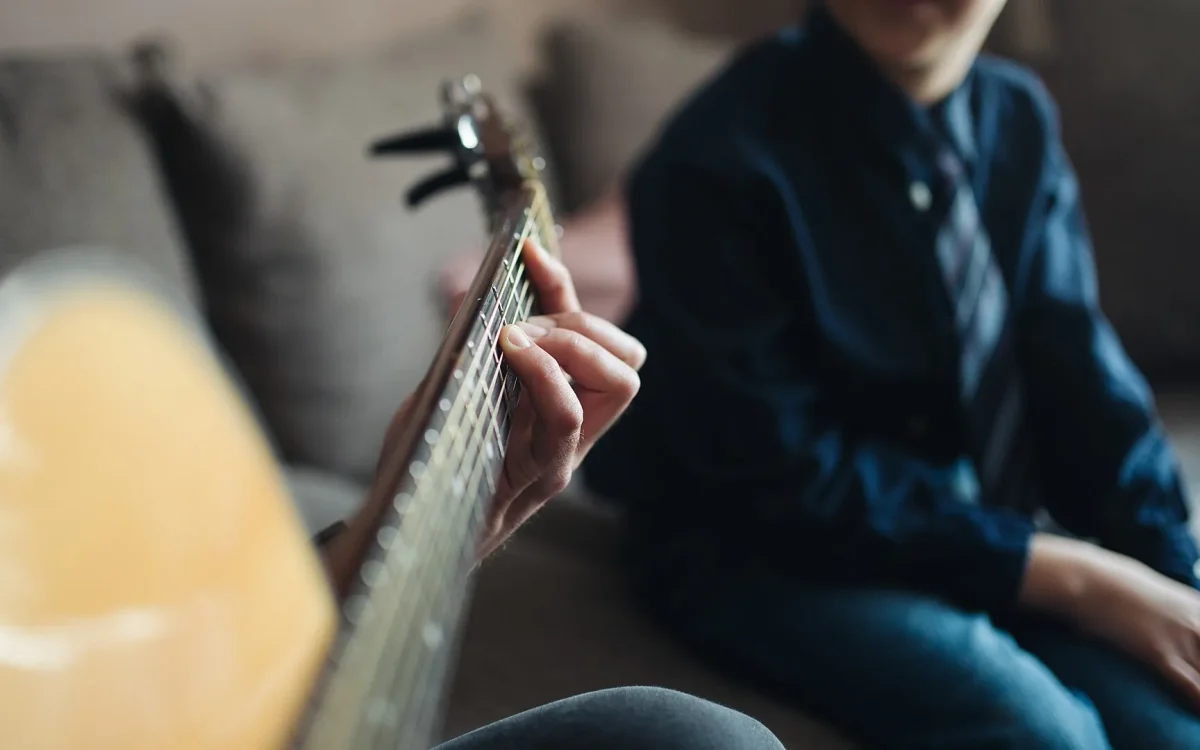
Sit your child on a chair with the guitar on their leg. They should be able to reach the first fret comfortably with their fretting arm slightly bent, not fully stretched. Their strumming arm should rest over the body of the guitar without their shoulder lifting. If they lean forward awkwardly or struggle to reach, the guitar is too big. It is tempting to buy a larger size to “grow into”, but an oversized guitar makes playing harder and can discourage a child completely.
Nylon or steel strings?
Classical guitars with nylon strings are the usual choice for young beginners. Nylon is gentler on fingertips, and the wider neck gives fingers space. Steel-string acoustic guitars sound brighter and suit pop and folk music, but the strings are harder on young fingers. Small electric guitars are another option for older children who love rock music: their light strings and slim necks are easy to play, but they need an amplifier. See classical, acoustic or electric and best guitars for kids.
Lessons: private, group or online
Private lessons give individual attention and are ideal for building correct posture and technique. Group lessons are sociable and often more affordable, and many children enjoy learning with friends. Online lessons work well for older children who can follow instructions on screen. Whatever you choose, look for a teacher experienced with children, who makes lessons fun and sets small, achievable goals. See questions to ask a music teacher.
Practice at home
Young children should practise little and often: ten minutes a day at six or seven, rising to fifteen or twenty minutes by nine or ten. Keep the guitar on a stand where it is easy to pick up, rather than zipped in a case. Help your child tune before each session, or use a clip-on tuner they can manage themselves. A sticker chart and our practice timer make daily practice feel like a game.
Sore fingers and early frustration
Every new guitarist gets sore fingertips at first. For children, this can be upsetting, so warn them in advance and keep early sessions short. The soreness fades within a few weeks as calluses form. If your child is still in pain after a month, check that the guitar is properly set up, as strings that sit too high make pressing much harder. See sore fingertips and calluses.
A closer look: when to move up a size
Children grow quickly, and a guitar that fitted perfectly may become cramped within a year or two. Signs that it is time to move up include the child’s knees lifting to hold the guitar, elbows bumping into their body, or fingers looking crowded on the frets. Many music shops offer trade-in or rental schemes that make upgrading affordable. When you move up, expect a few weeks of adjustment as the stretches feel longer; the extra space soon becomes comfortable and many children find chords easier on a guitar that fits them properly.
Putting it into practice
Start by measuring your child’s height and visiting a music shop to try two sizes. Choose nylon strings for a young beginner, a clip-on tuner and a simple stand. Find a teacher or a structured beginner course, set up a short daily practice time, and celebrate the first song. The Guitar Lesson Coach AI can suggest a gentle week-by-week plan for children.
Frequently asked questions
Is 5 too young to start guitar?
Many five-year-olds do better on a ukulele or a 1/4 size guitar with simple strumming and songs.
Should I buy a cheap guitar first?
Very cheap guitars are often hard to play. A modest, well set-up instrument is a better investment.
Can a child teach themselves guitar?
Older children can make progress with videos and books, but a teacher helps with posture and motivation.
Questions and notes