Key Signatures for Beginners
Key signatures tell you which notes are sharp or flat throughout a piece. How to read them, the order of sharps and flats, quick tricks to name the key, major and relative minor keys, and common beginner keys.
In this guide
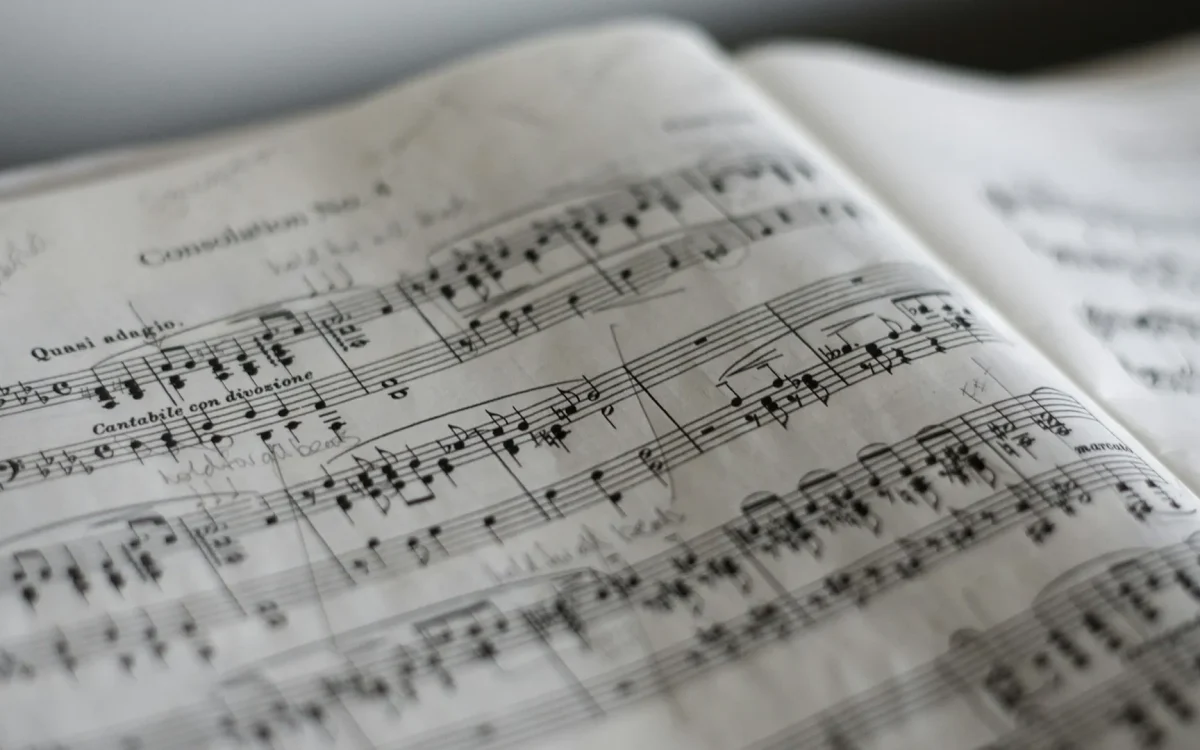
At the start of most pieces of music, just after the clef, you will see a group of sharps or flats. This is the key signature. It tells you which notes are played sharp or flat throughout the piece, and it tells you the key the music is in. Key signatures look confusing at first, but a few simple rules make them easy to read. This guide explains everything a beginner needs to know.
What a key signature does
A key signature saves writing the same sharps or flats again and again. If a piece is in G major, every F is played as F sharp. Instead of writing a sharp beside every F, the key signature places one sharp on the F line at the start of each line of music. That sharp applies to every F, in every octave, throughout the piece, unless a natural sign cancels it. See sharps, flats and naturals.
No sharps or flats: C major
If there is no key signature, the piece is usually in C major (or A minor). These keys use only the natural notes, the white keys on the piano. Many beginner pieces are in C major for this reason.
The order of sharps
Sharps always appear in the same order: F, C, G, D, A, E, B. A popular memory phrase is “Father Charles Goes Down And Ends Battle”. A key with one sharp has F sharp; two sharps, F and C sharp; three, F, C and G sharp; and so on. You will never see a key signature with just C sharp and no F sharp.
The order of flats
Flats appear in the reverse order: B, E, A, D, G, C, F. The phrase “Battle Ends And Down Goes Charles’ Father” reverses the sharp phrase. A key with one flat has B flat; two flats, B and E flat; and so on. The first four flats spell “BEAD”, which is an easy way to remember them.
Trick for sharp keys
To find the major key of a sharp key signature, look at the last sharp (the one furthest to the right) and go up one semitone. If the last sharp is F sharp, the key is G major. If the last sharp is C sharp, the key is D major. This works for every sharp key.
Trick for flat keys
For flat key signatures, the second-to-last flat names the key. If the flats are B flat and E flat, the second-to-last is B flat, so the key is B flat major. If there are three flats (B, E, A), the key is E flat major. The only exception to learn separately is one flat, which is F major.
Common keys at a glance
| Key signature | Major key | Relative minor |
|---|---|---|
| None | C major | A minor |
| 1 sharp (F♯) | G major | E minor |
| 2 sharps (F♯, C♯) | D major | B minor |
| 3 sharps (F♯, C♯, G♯) | A major | F♯ minor |
| 1 flat (B♭) | F major | D minor |
| 2 flats (B♭, E♭) | B♭ major | G minor |
| 3 flats (B♭, E♭, A♭) | E♭ major | C minor |
Major and relative minor keys
Every key signature is shared by one major key and one minor key, called its relative minor. The relative minor starts on the sixth note of the major scale, or three semitones below the major key’s name. C major and A minor share no sharps or flats; G major and E minor share one sharp. To tell whether a piece is major or minor, look at the first and last notes or chords, and listen: minor pieces often sound darker. Minor pieces also frequently include a raised seventh note as an accidental, such as G sharp in A minor.
The circle of fifths
Musicians often arrange keys in a diagram called the circle of fifths. Moving clockwise, each key is a fifth higher and adds one sharp: C, G, D, A, E, B, and so on. Moving anticlockwise, each key adds one flat: C, F, B flat, E flat, A flat. The circle shows how keys relate and is useful for understanding chords and harmony. Beginners do not need to memorise it immediately, but it is a helpful map to know about.
Reading pieces with key signatures
Before playing a piece, look at the key signature and say which notes are sharp or flat. Circle a few of those notes in the music as reminders if needed. Play the scale of the key as a warm-up, which helps your fingers and ears get used to the sharps or flats. Watch for accidentals that temporarily change notes within a bar. See the major scale explained simply.
A closer look: why keys matter
Keys allow music to be played at different pitches to suit different voices and instruments. A song might be too high for one singer in G major but comfortable in E flat major. Keys also have practical effects on instruments: some keys are easier to play on guitar (such as G, D, A and E) while wind instruments often prefer flat keys. Understanding keys helps you transpose, choose songs and understand why music is written the way it is. See choose songs for your voice.
Putting it into practice
Learn the order of sharps and flats this week, and practise naming keys from key signatures using the tricks above. Look at the key signature of every piece you play and say which notes are affected. Play the matching scale as a warm-up. The Note Reading Tutor AI can quiz you on key signatures, and our note reading trainer builds general reading speed.
Frequently asked questions
How do I know if a piece is major or minor?
Look at the first and last notes or chords, check for a raised seventh, and listen to the overall mood.
Do key signatures apply to all octaves?
Yes. A sharp or flat in the key signature applies to that note in every octave.
Which key signatures should beginners learn first?
C, G and F major, followed by D major and B flat major.


Questions and notes